Aegina Hellanion Oros – excavation and survey
Excavation on the mountain peak of Zeus
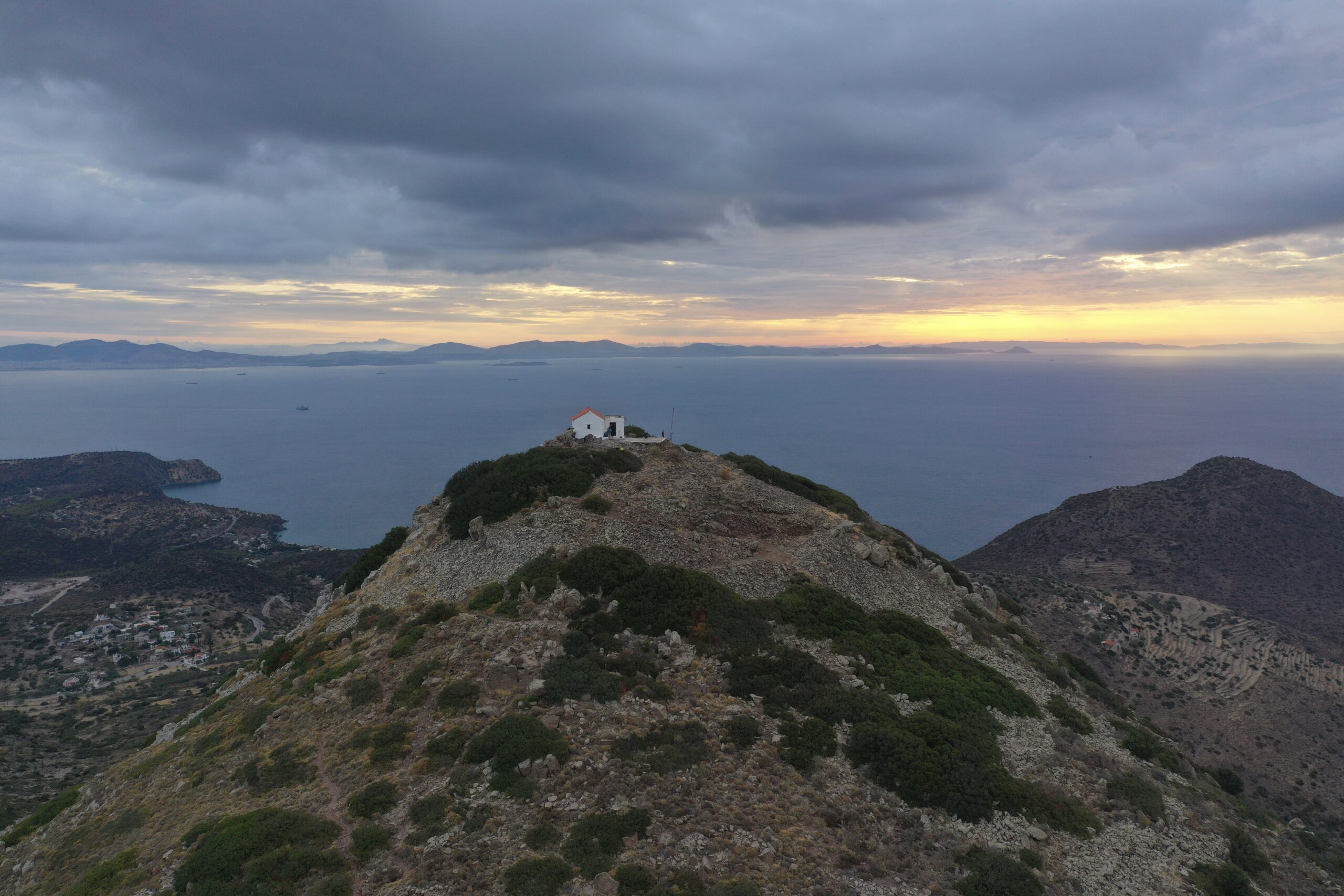
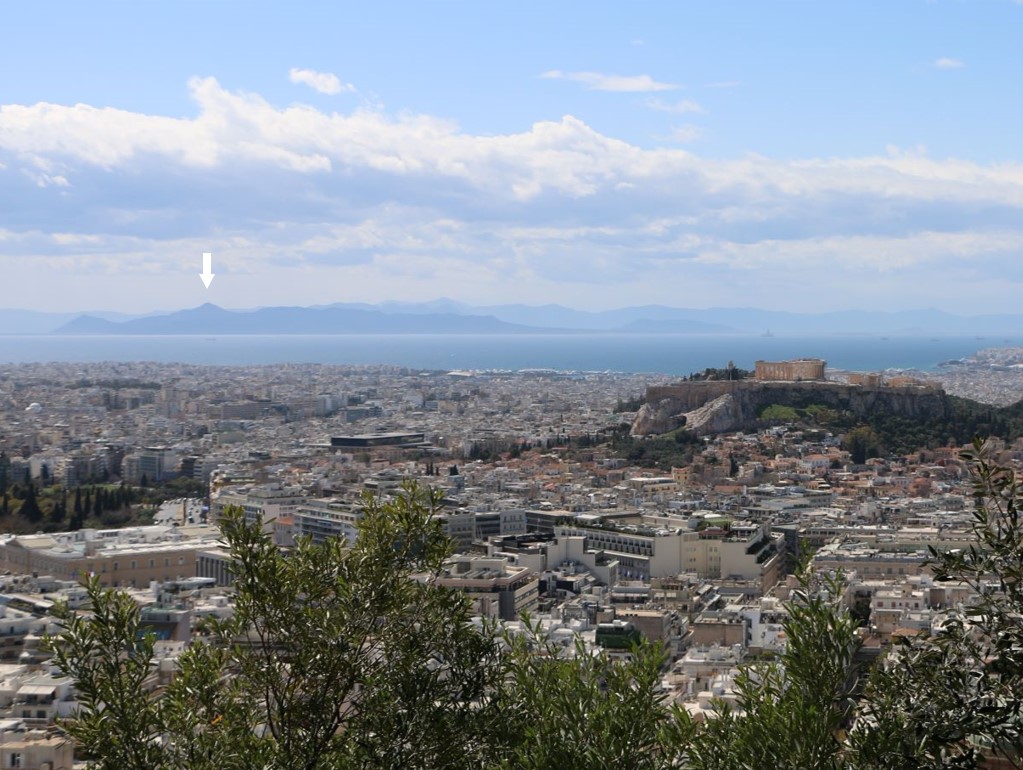
According to ancient literature, the highest peak on the island of Aegina, Hellanion Oros, was dedicated to Zeus as a god of rain. According to the myth, Aiakos, son of Zeus and king of Aegina, built an altar to his father here following the advice of the Delphic oracle, so as to alleviate a drought that had affected the whole of Greece. The site is a major landmark since it is visible from all around the Saronic Gulf, including Athens. Today the summit is crowned by a chapel dedicated to the Ascension (Analipsi), built on an ancient foundation. In the first half of the 20th century, excavations on the mountaintop revealed remains of the ancient sanctuary, but also of a prehistoric settlement. However, the results of these investigations were never published in detail and only a few finds were kept. The site is nonetheless often mentioned in archaeological literature, as it appears to be closely linked to the destiny of Aegina, an island with a turbulent history swinging between naval supremacy and subjugation by rival powers.
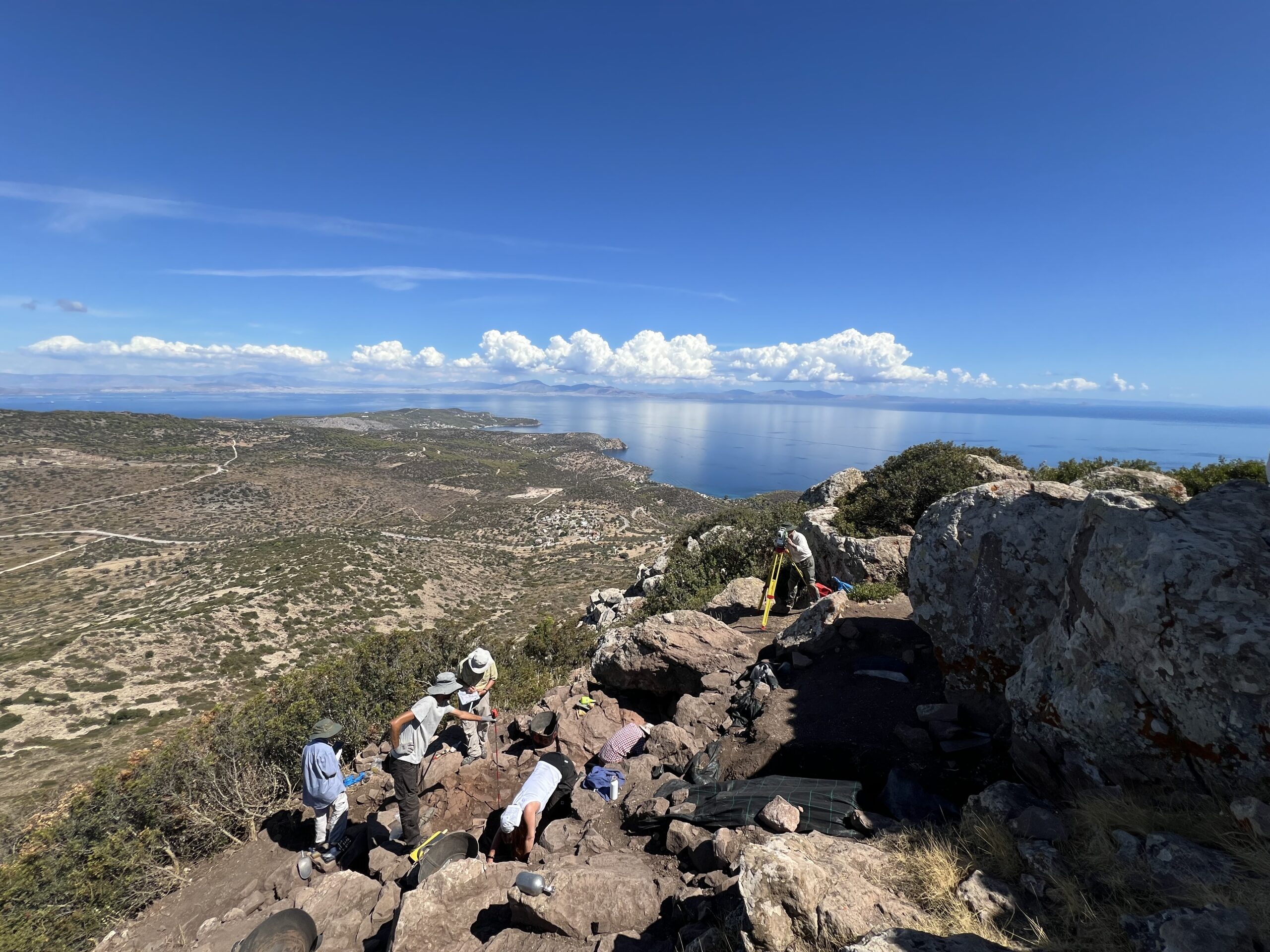
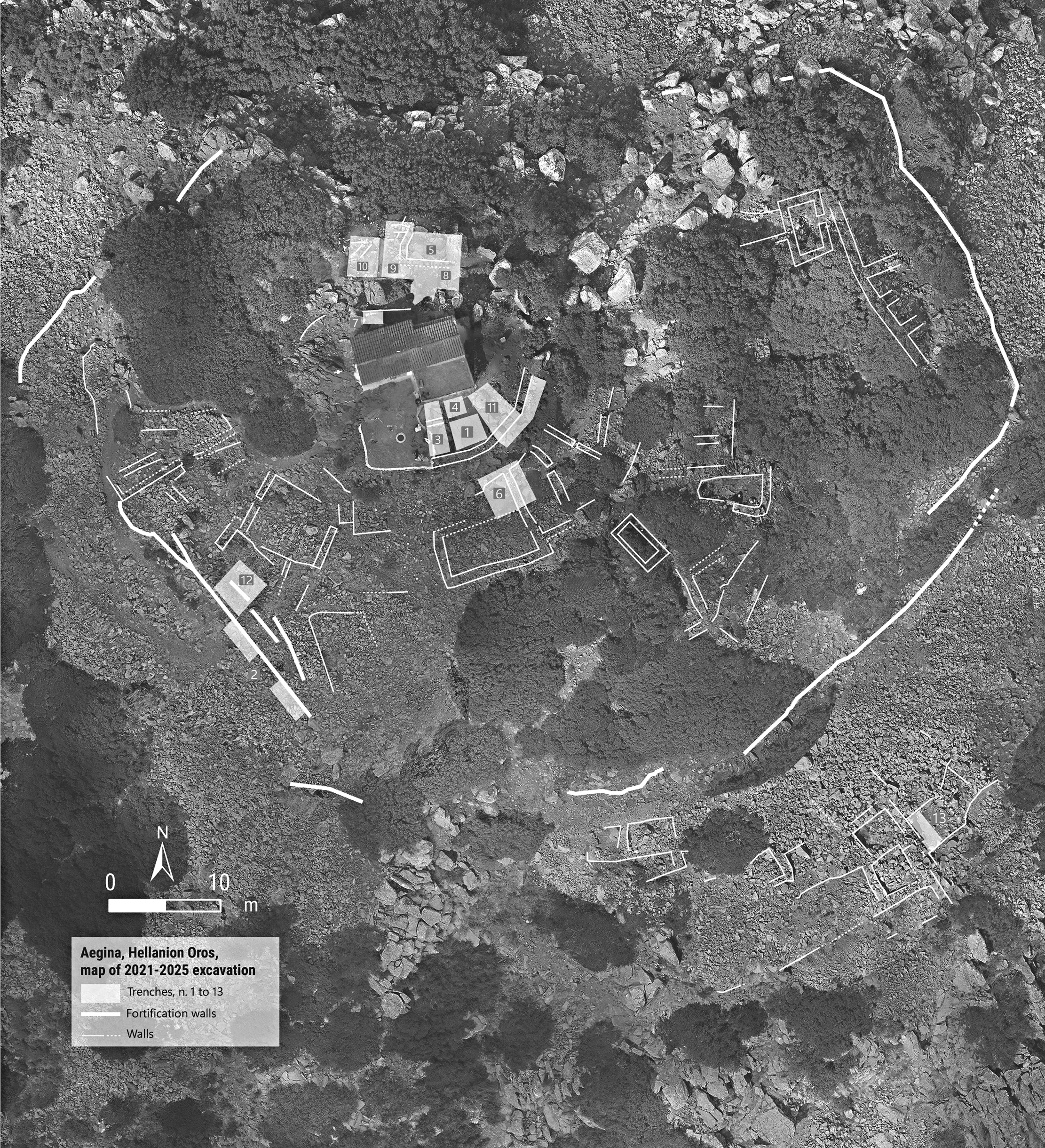
The ESAG and the Ephorate of Antiquities of Piraeus and the Islands established a collaboration in 2021 to investigate Hellanion Oros. In the five years from 2021 to 2025, thirteen trenches were opened in order to trace the site’s development through time and to understand its relation to the better known monumental building complex situated lower down on the northern slope, which is equally connected to the cult of Zeus. The excavation is not an easy undertaking, as all equipment has to be carried up to the summit and the site is highly exposed to the weather. But the view over the Saronic Gulf and towards the western Cyclades, Attica and the Peloponnese is most rewarding. Several other mountaintop sanctuaries dedicated to Zeus are in fact visible from the summit, such as those on Mounts Hymettos and Parnitha near Athens, and Mount Arachnaion in the Argolid.
In most trenches, a black layer containing thousands of tiny fragments of burnt animal bones attests to the sacrifices that took place on the summit. The ceramic finds show that the sanctuary functioned for at least a millennium, from the Geometric period (8th c. BCE) until Roman times. Fragments of large roof tiles of Corinthian type further indicate the presence of a roofed building in antiquity, most probably a small temple built on the spot now occupied by the chapel.
Bronze Age remains
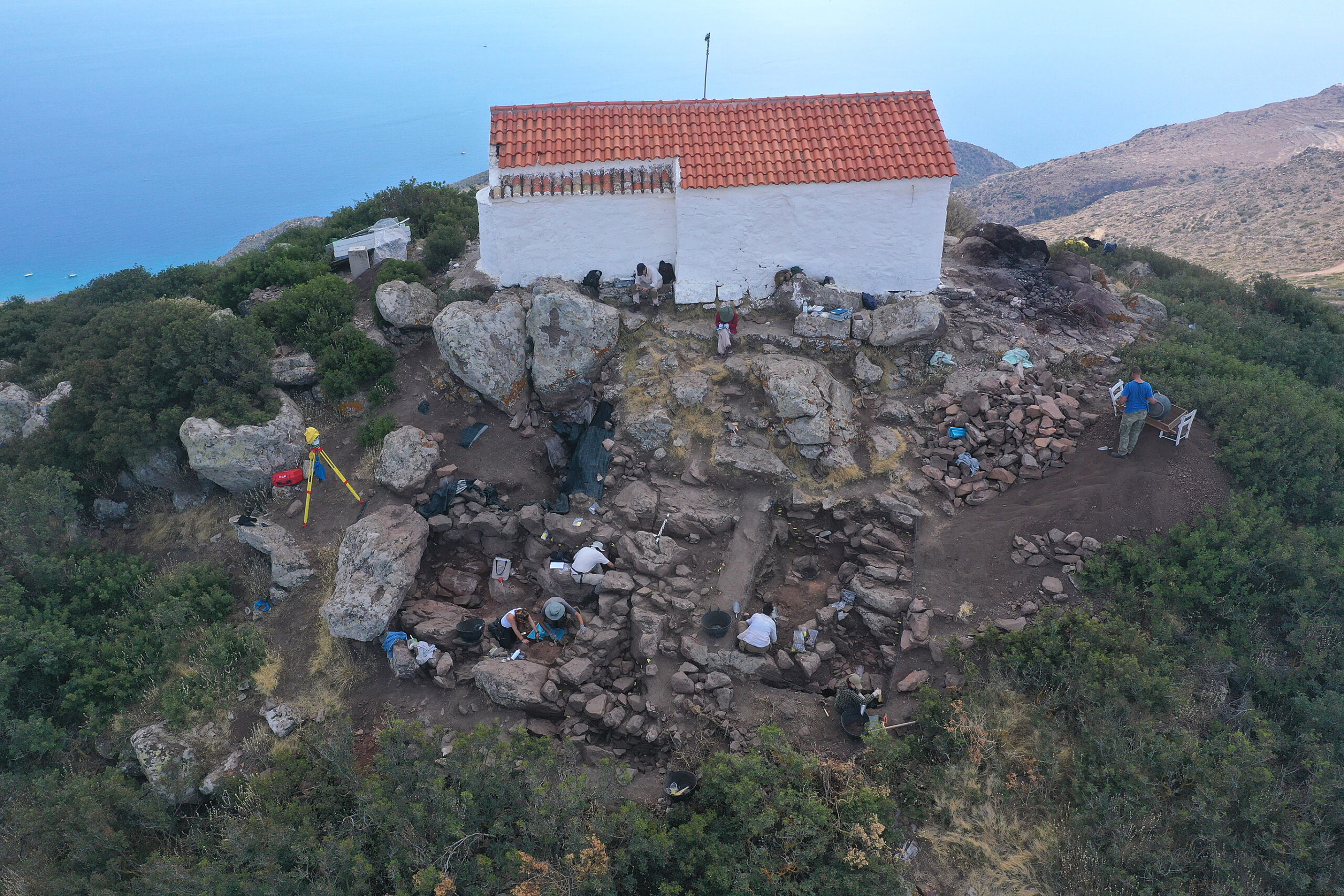
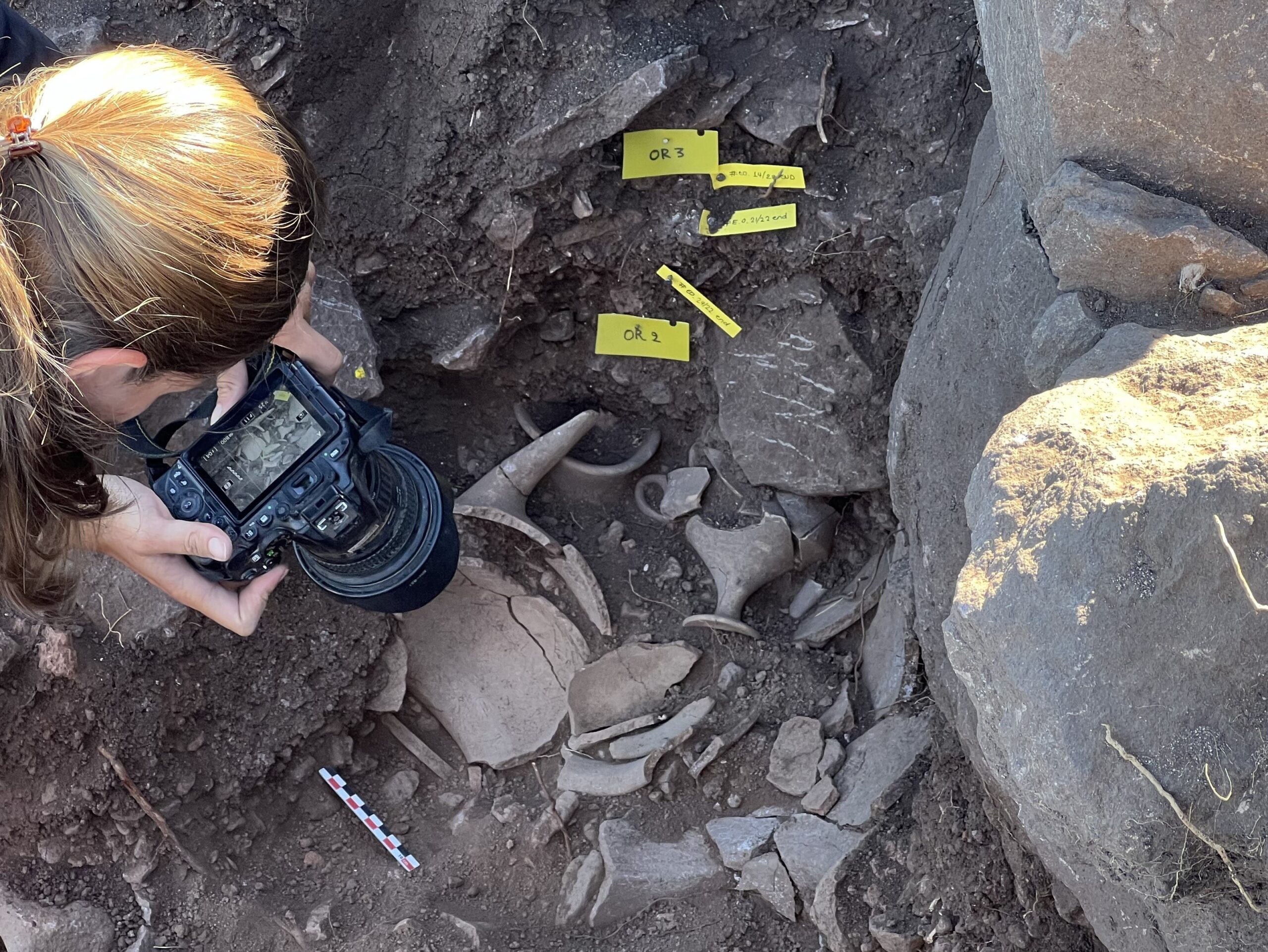
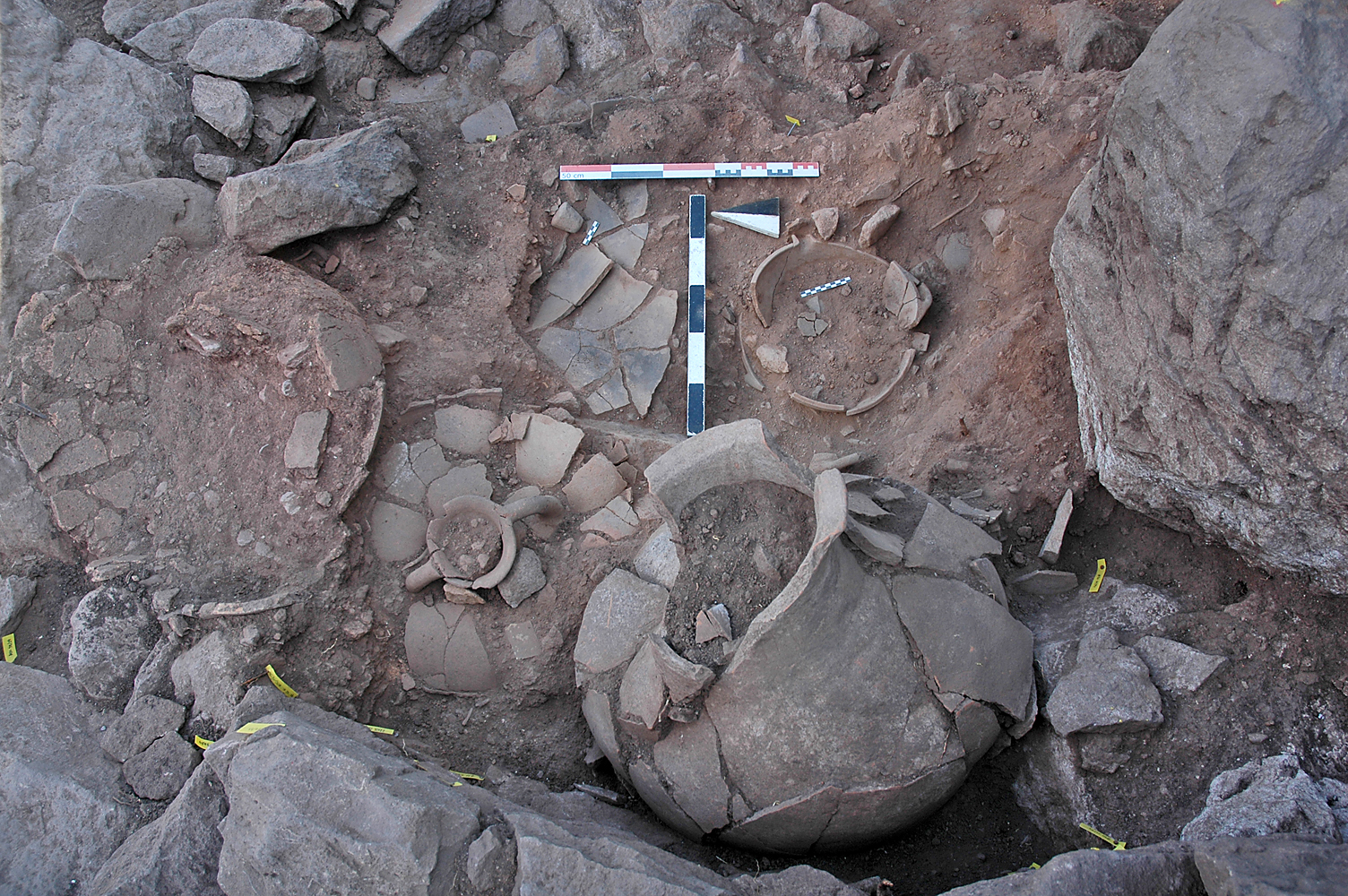
The site’s history, however, goes further back in time. Immediately north of the chapel, in a sector untouched by the earlier excavations, well-preserved remains of small buildings from the end of the Bronze Age came to light, covered by the burnt deposits of the later sanctuary. One of the rooms contained dozens of household vessels — from drinking cups to jugs and tripod cooking pots, as well as large storage containers — shattered in place when the building collapsed. This pottery dates to the very end of the Mycenaean period, in the 12th c. BCE (Late Helladic [LH] IIIC), a time of profound transformation in the Aegean world, when the palatial culture and its centres at sites such as Mycenae were destroyed. Coastal areas were no longer safe, and it may well be that part of Aegina’s population fled to this summit, where a fortified village was built. In this regard, Hellanion Oros is indicative of how local communities reacted to the collapse at the transition from the Bronze Age to the Iron Age. The relationship between these LH IIIC remains and a large Mycenaean complex of several rows of rooms on the southern slope, investigated in 2025, is not yet clear. The traces of metalworking found in the single room excavated so far confirm that the settlement was occupied permanently for a certain period and not only used as a place of refuge during urgent need.
The people who settled at the summit of Hellanion Oros may have chosen the site not only for its location, far from the sea and hard to reach, but also because it was already familiar to them: finds from even earlier periods, reaching back at least to the Middle Bronze Age (first half of the 2nd millennium BCE) were detected in the deepest layers above the bedrock. They reveal activity well before the collapse, when Kolonna, the main settlement of Aegina, was a major trade hub. A permanent habitation on the summit seems most unlikely for this period; instead, the evidence is indicative of a cult place. It is tempting to imagine that the ritual use of the summit was inspired by Aegina’s contacts with Minoan Crete, where peak sanctuaries were a major feature. A wheel-made clay figurine of the Mycenaean palatial period (14th–13th c. BCE), found during the earlier investigations on Hellanion Oros, also points to the existence of a sanctuary, as such figurines are normally interpreted as evidence of cult activity. In sum, the evidence that is now available suggests cultic use of the summit over a particularly long time, being only briefly interrupted by the presence of the refuge settlement.
Excavation of the Late Helladic IIIC remains north of the chapel.
Survey in Southern Aegina
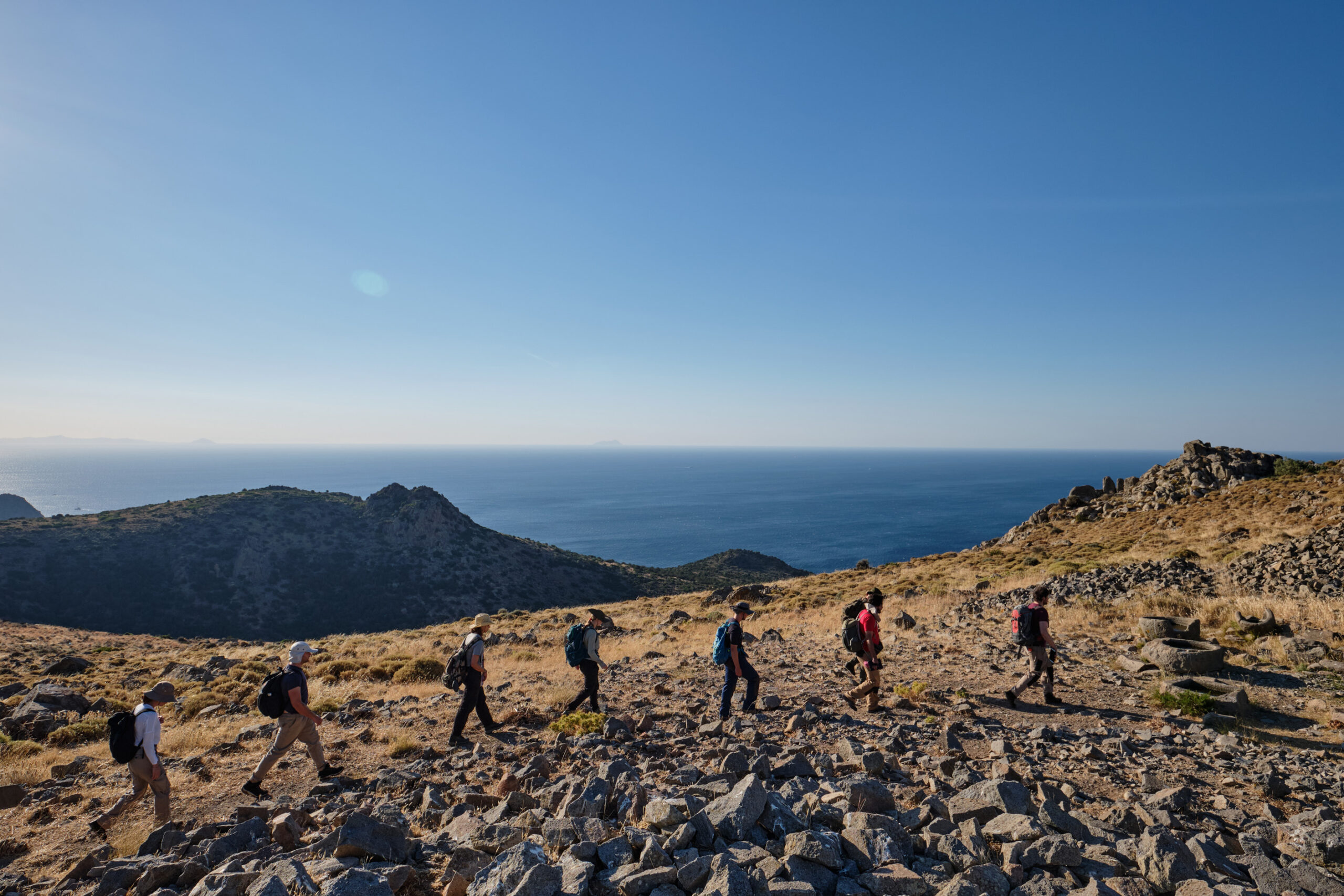
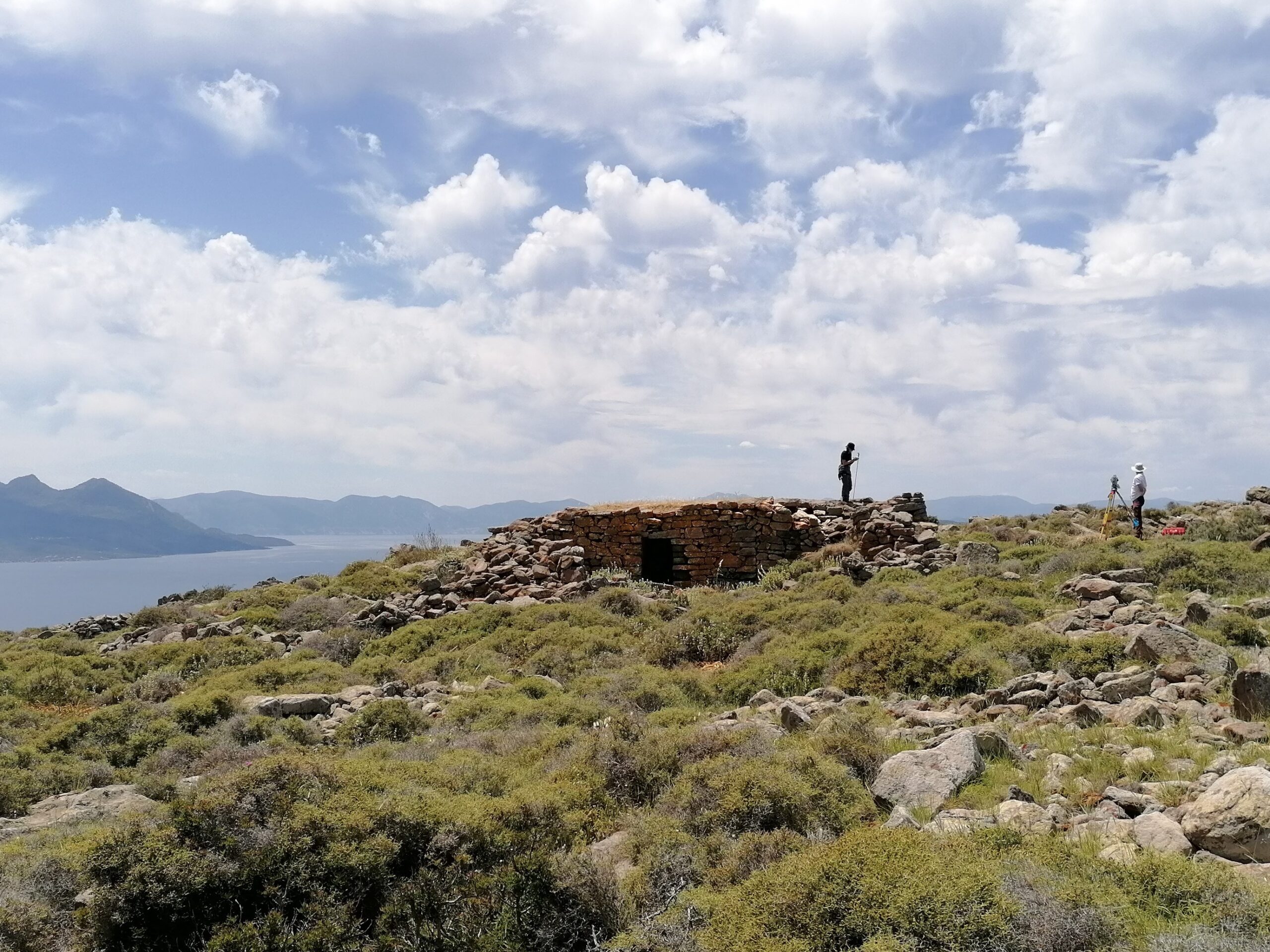
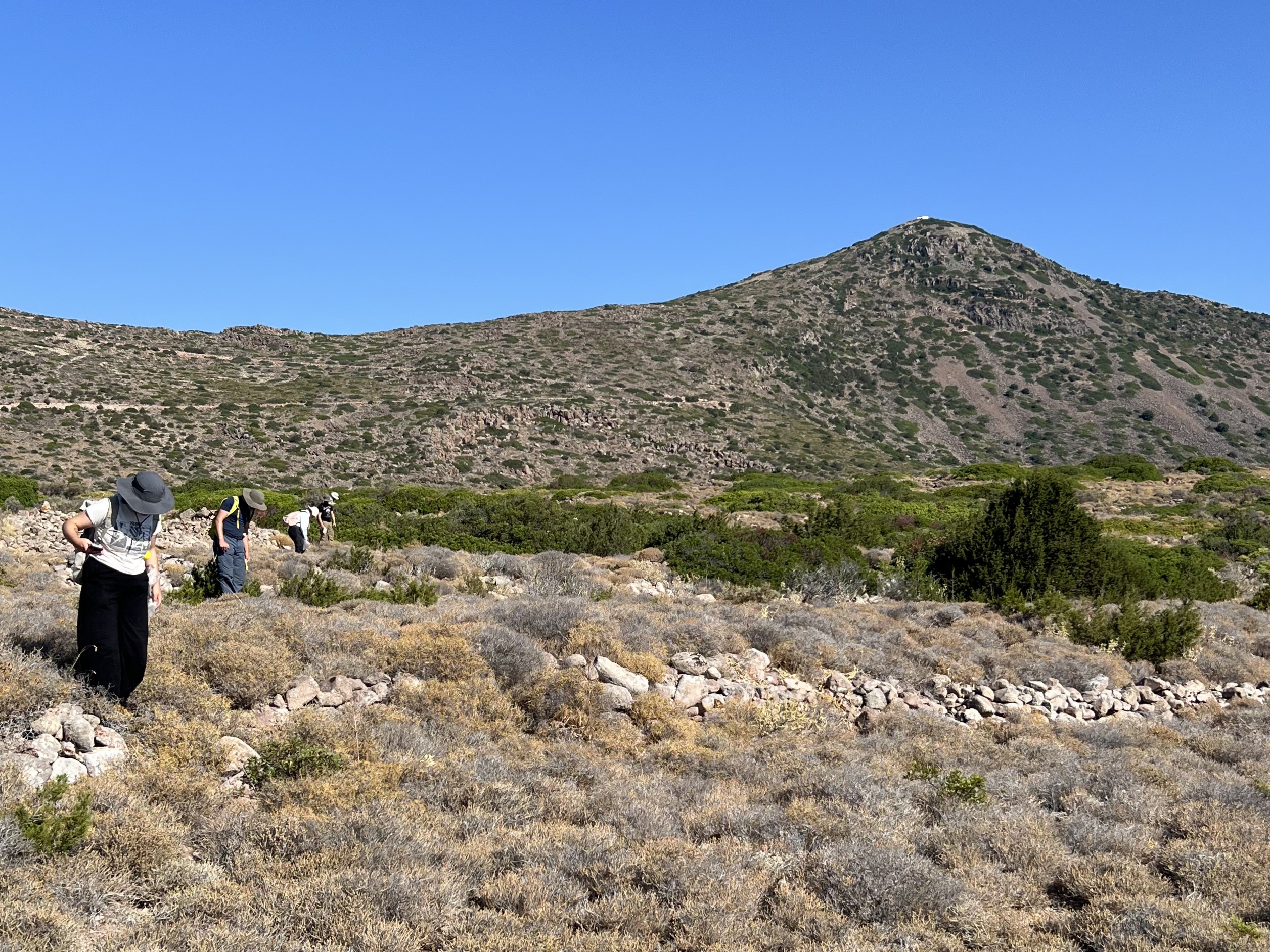
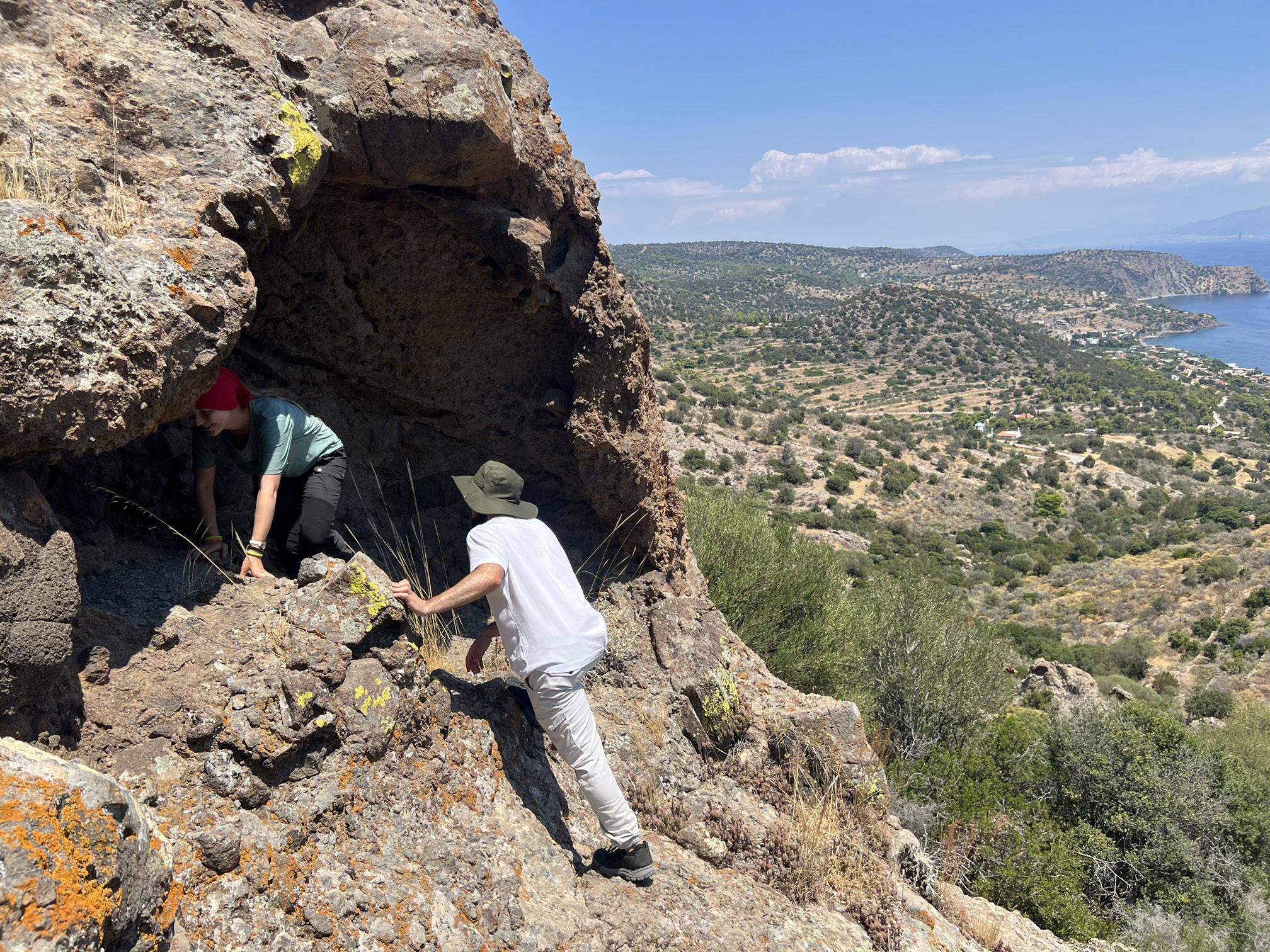
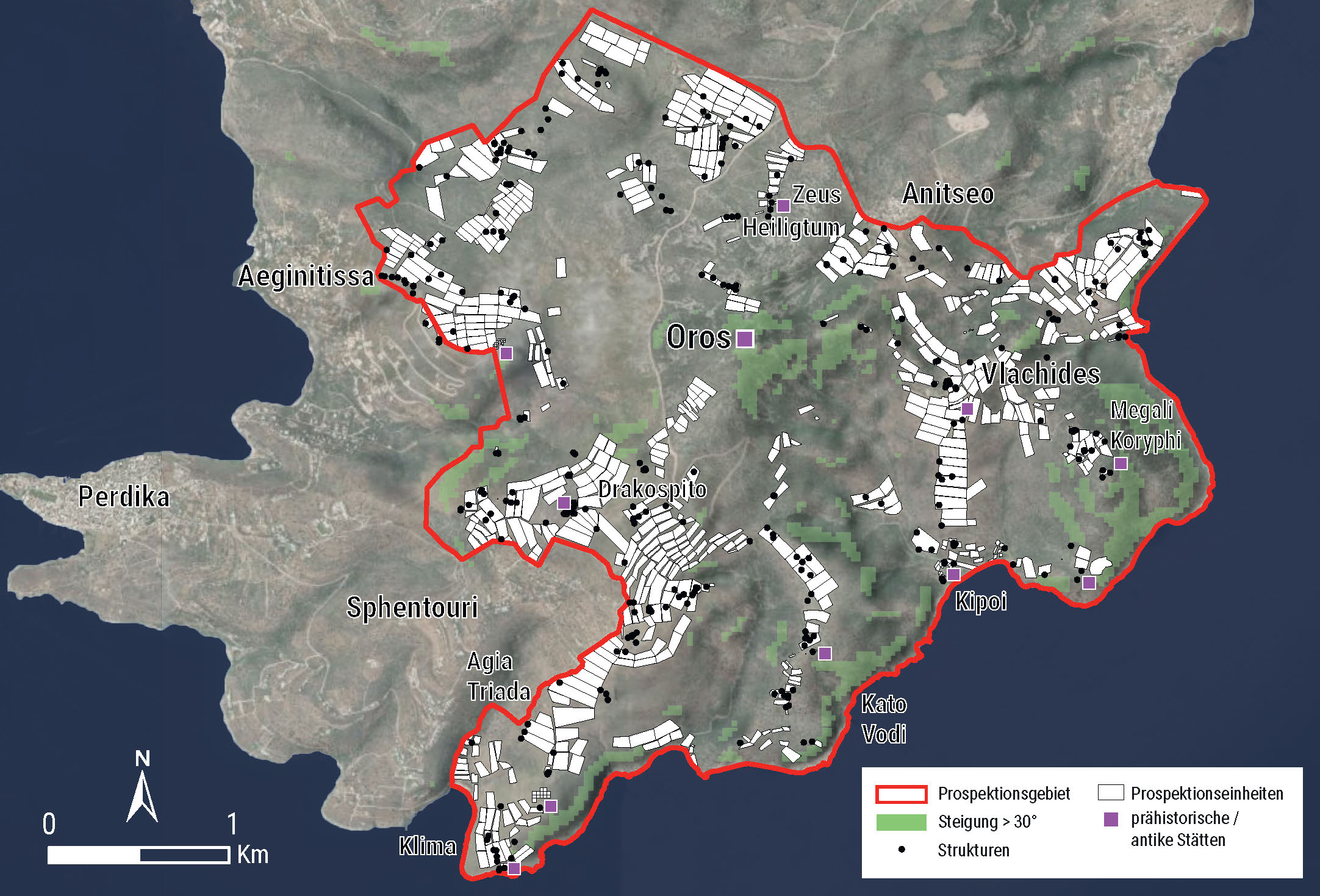
With this complex picture in mind, a regional survey of southern Aegina was also included in the project. The survey covered the areas around Hellanion Oros, that is about an eighth of the island, the aim being to enable a better understanding of the site within its environment. Although this part of the island is largely abandoned today, a glance from the summit or at satellite images is enough to show that it was intensively used for habitation and farming earlier. Alongside the excavation, four short campaigns of intensive and extensive survey took place from 2022 to 2025; a larger campaign was carried out in 2026, the first year of a second five-year project. Through systematic field-walking, more than 700 survey units have been covered. Although the rugged terrain makes systematic walking difficult, more than 350 structures have been documented and more than 52,000 sherds counted, dating from the Final Neolithic / Early Bronze Age to the early 20th century. Furthermore, over 550 tools of obsidian and flint have been collected. Thus, a picture of intensive human activity spanning at least 5,000 years emerges. The project has also led to the discovery of new sites around Hellanion Oros, including a hilltop settlement of the Final Neolithic / Early Bronze Age, the earliest site in the area known so far. Later in the Bronze Age, fortifications were built at prominent locations in southern Aegina. For the historical periods, boundary inscriptions (horoi), cisterns (the so-called souvales), fortifications, terrace walls, quarries and scatters of finds bear witness to intensive land use. Even a so-called drakospito – a “dragon house”, built by giants according to legend – stands in this mountainous region (see here for the project on similar structures in Southern Euboea). The building, as the region itself, must have seen many different uses throughout its millennial history.
2027–2030
From 2027 onwards, the team will return to the summit for excavation on a broader scale. Much effort in the previous campaigns went into the meticulous excavation of the well-preserved LH IIIC building. The project now aims to come back to the initial goals: the documentation of the peak’s use through time and the detection of further traces of the sanctuary of Zeus as well as of its Bronze Age predecessor. The clarification of the chronology and function of the Mycenaean building complex on the southern slope will also be a significant part of the work planned for the years to come.
As all the projects of the ESAG, the Hellanion Oros excavation offers fieldwork opportunities to numerous archaeology students. In the last five years, students from the universities of Basel, Geneva, Lausanne, Neuchâtel, Zurich, Athens, Ioannina, Thessaloniki, Volos, Heidelberg, Poitiers, Louvain-la-Neuve, Oxford and New Jersey participated in the project.
Project team
Project directors: Tobias Krapf and Stella Chryssoulaki
Project members: Sophia Michalopoulou, Leonidas Vokotopoulos, Jérôme André and François De Polignac
Finds management: Christina Pagoni
Archaeozoology: Angelos Gkotsinas
Archaeobotanics: Angeliki Karathanou
Anthropology: Maria Liston
Further reading
ESAG Annual reports and Antike Kunst
For previous work, research history and further bibliography about the site:
T. Krapf – S. Chryssoulaki – F. de Polignac – L. Vokotopoulos – S. Michalopoulou – J. André, Le sanctuaire de Zeus au sommet de l’Hellanion Oros sur l’île d’Égine, in: D. Lefèvre-Novaro – C. Voisin (eds), Sanctuaires et paysages, Actes (Strasbourg 2025) 264–276.
For the cult of Zeus on mountaintops, see F. De Polignac, Perceptions et constructions du paysage religieux en Grèce ancienne: formes et fonctions de la centralité, in: S. Verdan, S. Fachard – T. Theurillat (eds), Reconstructing Greek Sacred Landscapes. Dynamics and Approaches from the Field (Oxford 2026) 53–68 (open access link).
Press release 2023: Swiss-Greek excavation of the sanctuary of Zeus on the island of Aegina